Spitzer Documentation & Tools
IRAC Warm Image Features and Caveats

(last update November 23, 2010)

This page discusses significant features of data taken with the warm IRAC instrument. Generally, IRAC continues to operate in the same manner as it did when cryogenically cooled. However, there are some differences which are outlined in greater detail here. Users are advised to study the cryogenic data caveats page and in particular the Warm Spitzer Observer's Manual (SOM). The Warm SOM has been updated to reflect new information regarding the operation and characteristics of the warm IRAC instrument. Additional information is presented here for emphasis, or as an update to the information in the SOM.

The calibration of warm IRAC is a work in progress. In general, changes have been made to the calibration as new and improved products have become available. All warm campaigns have been reprocessed as of July 2010 with the latest calibrations as described in this memo. The processing version for the current calibration of warm data is S18.18.

1. Transition Period from Cold to Warm Operations (Temperatures and Voltage Setpoints)

On May 15, 2009 Spitzer depleted the last of its cryogen. What followed was a multi-month phase during which the telescope and instrument slowly warmed to their new equilibrium temperature. At the same time, numerous changes were made to IRAC in order to improve its performance at the new temperature. It is important to understand this, because the calibration of IRAC (the specific files and conversions used), as well as its calibration accuracy, changed several times. Any user working with data taken between May 15 and September 18, 2009 must be aware of these issues. Data products supplied by the SSC are calibrated with the best calibration available at the time of processing, and most users should not need to apply any additional corrections. However, users must be aware that they should not interchange calibration data within this time period, or with that from the cryogenic mission.

The applied bias on the arrays and the operating temperature were modified during the initial two months of science observations to improve the final sensitivities. The changes were implemented after it was determined that the power dissipated by the instrument was lower than predicted. The lower power dissipation allows the instrument to be run at a lower temperature than initially planned, with a significant improvement in noise properties and sensitivity. Unfortunately, the instrument chamber overshot the lower equilibrium temperature before the setpoints could be revised. Therefore, three separate calibration phases exist for warm IRAC. The initial calibration applies for data from the initial characterization through the first warm science campaign (18 June 2009 - 12 August 2009). The arrays had 450 mV of applied bias and were operating at a temperature of 31 K. From 2009-224T18:55:00.900 (12 August 2009) to 2009-262T00:47:02.180 (18 September 2009) data were taken with the array temperatures allowed to float and 450 mV of applied bias. During this interval, the array temperatures lowered from 29.2 K to 28.5 K. From 2009-262T00:47:02.180 onward, the voltages have been set to their final values of 500 mV of applied bias and array temperatures to 28.7 K. Lower temperatures and higher applied biases produce increased effective throughput and lower flux conversion values (referred to as FLUXCONV in the IRAC Instrument Handbook).

2. Data Processing

Warm IRAC data are processed using the same methodology as cold IRAC data. The main differences in processing are that there are no laboratory bias measurements to use and the muxbleed correction is not applied as it is no longer needed. The calibration files applied (specifically flats and linearization) are described in the following sections.

3. Absolute Flux Calibration and Uncertainty

The current temperatures, biases, and flux conversion values (MJy/sr per DN/s) for channels 1 and 2 (3.6 and 4.5 microns) are


Flux Conversions
DatesCampaignsSCLK_BEGSCLK_END Array TemperatureApplied BiasCh 1 FLUXCONVCh 2 FLUXCONV
Cryogenic 15 K 750/500 mV 0.1088 ± 0.0022 0.1388 ± 0.0027
18 June 2009 - 12 August 2009 IRACPC1 933191512.856 934571294.269 31 K 450 mV 0.1245 ± 0.0042 0.1490 ± 0.0059
12 August 2009 - 18 September 2009 IRACPC2 - IRACPC4 934571294.270 937789877.199 29-28.5 K 450 mV 0.1219 ± 0.0132 0.1480 ± 0.0150
18 September 2009 onward mid-IRACPC4 onward 937789877.200 999999999.999 28.7 K 500 mV 0.1253 ± 0.0054 0.1469 ± 0.0065

The specific flux conversion applied to any given data is found in the image header as FLUXCONV. The uncertainties listed in the table for the flux conversions are the formal uncertainties in the derivation of the conversion factors from the calibration stars and do not include the 1.5% uncertainty in the estimates of in-band truth. In general, the calibration has been determined using the methodology outlined in the cryogenic calibration paper (Reach et al. 2005) and using the same primary and secondary calibration standards as used in the cryogenic mission. The uncertainties for the IRACPC-5 and onward data will improve as more data are collected and we expect final absolute uncertainties of ~3% (as in the cryogenic mission). For the earlier campaigns, it is likely that the uncertainties will not improve significantly.

In detail, there are a few significant changes. First, the pixel-phase effect can no longer be well described as a one-dimensional function of distance from pixel center. Instead, a two-dimensional function with a peak response off of pixel center is appropriate. Finally, for the end of IRAC-PC4 and onward, the data have been processed with a more correct linearity solution.

As all warm campaigns use the latest appropriate flux conversions, the photometric scaling that previous versions of this memo recommended does not need to be done. However, observers should make sure that the flux conversions for the data that they are using match the values in the table above.

3.1 Bright Source uncertainties

In general, the uncertainty in the measured flux of any source is a combination of photon noise of the source and background, readnoise of the observation, the propagated error of the data calibration steps (including dark subtraction, linearity correction and flat-fielding), uncertainty in the pixel phase and location-dependent photometric corrections, as well as the uncertainty in the transfer of photometric truth through the flux conversion value.

For high signal-to-noise, well-dithered observations, the photon noise, readnoise, pixel phase and location-dependent correction uncertainties are small compared to the uncertainty in the absolute calibration (4%) and pipeline processing. The uncertainty in the pipeline processing for bright sources is currently dominated by the linearity correction for IRACPC-1 through IRACPC-4. For data in those campaigns, we estimate the total uncertainty for bright sources to be 5%-7% in channel 1 and ~4% in channel 2. For data in IRACPC-5 and onward, the linearity solution is good to better than 1% for all sources below saturation. The total (and conservative) uncertainty for these data is 4%. The uncertainty will improve as the calibration baseline lengthens just as the calibration improved during the course of the cryogenic mission.

The relative uncertainty for bright sources (either trending the flux of a source with time or comparing to IRAC measurements of other sources) is much better. For staring observations of very bright sources, precisions of ~10-4 are possible at least on timescales of an hour or less. For longer baselines or coaddition of multiple epochs, correlated noise (the residuals of the pixel-phase effect) can limit signal-to-noise but in a fashion which is dependent on the individual data set and the reduction methods used. Conservatively, observers can expect precisions of 1.3 × σP × N-0.4, where σP is the theoretical photon noise of one observation and N is the number of observations.

An indication of how the photon noise in the warm mission compares to the cryogenic mission is sqrt(Gw × FCc / Gc × FCw) where Gw,c are the warm and cryogenic gains (3.7 and 3.3 at 3.6 μm and 3.71 at 4.5 μm) and FCw,c are the warm and cryogenic flux conversions. Using the final setpoint values, the photon noise compared to cryo is approximately the same at 3.6 μm and 2% higher at 4.5 μm.

3.2 Faint Source uncertainties

For low (less than 10) signal-to-noise sources, the uncertainty in the measured flux is dominated by the readnoise and the structure/clutter of the background. During the initial warm characterization and the warm recalibration, dedicated measurements of the noise for faint, extragalactic sources were made using repeated observations of the IRAC dark field and masking of all known sources. The data used were seven repeats of 100 second frames at a particular position with 3 dithers. The noise level in a 100 second frame is 8.12 and 9.98 kJy/sr for 3.6 μm and 4.5 μm,respectively. Since no analogous measurement was made in the cryogenic mission, the results are compared to the model noise for cryogenic IRAC from the SENS-PET tool in the following figure.


Deep image noise plot

After the final calibration, the deep image noise is 12% worse than cryo at 3.6 μm and 10% better at 4.5 μm where there is a ~10% uncertainty in the noise measurement. For data taken prior to 12 August 2009, the performance is poorer with the noise ~20% and ~10% greater than cryo at 3.6 and 4.5 μm, respectively. The actual noise for a given observation is a strong function of the data-taking strategy, structure in the background and method used to measure photometry.

3.3 Photometric Stability

The photometric stability of IRAC has been measured using both a 36-hour sequence of standard skydark and calibration star observations and a set of high precision photometric monitoring observations. An initial analysis shows that the warm IRAC exhibits the same photometric stability as in the cryogenic mission. The standard calibration star measurements do not vary in time to better than 2%. The high precision photometry observations were able to recover about 80% of the Poisson limit which compares quite favorably with cryogenic observations which reached 70% of the Poisson limit. High precision photometric observations are limited in precision by the ability to remove the pixel-phase effect and the intrinsic Fowler sampling of the observations. There are no indications that residual images cause a time variability in the observed light curves. However, some observers have noted slight trends of flux with time during staring mode observations, so it may be appropriate to remove a linear trend with time. Further calibration data are being taken to investigate these effects.


Relative stability of a bright star observed in subarray mode over a one hour time period.

3.4 Pixel Phase Correction

Information about intrapixel sensitivity variations (pixel phase correction) for warm IRAC data is available on this page.

3.5 Array Location-Dependent Photometric Correction

Based on our analysis of observations of IRAC calibration stars, the location-dependent photometric correction has changed from the cold IRAC correction. After the final array setpoint determination, a standard star (BD+67 1044) was observed over a densely spaced grid on each array and the position dependency of the photometry mapped. As with the cryogenic location-dependent correction, the variation is reasonably fit by a 2nd order polynomial in array coordinates (x, y).

For well-dithered data, the photometric variation should average out. Observations of sources towards the center of the array will also have minimal corrections.

Download the channel 1 and channel 2 correction images. Photometry of blue sources (sources with SEDs falling with increasing wavelength) should be multiplied by the value of correction image at the centroid location of the source.


From the Warm SOM Figure 6.13: Photometric correction images at 3.6 microns (left) and 4.5 microns (right). The contours start at 0.95 for 3.6 microns and 0.94 for 4.5 microns and increment by 0.01. The correction images are normalized to the average response of the array.

4. Optical Properties of the Arrays

The optical properties of the telescope and instrument have not changed measurably since the cryogenic mission. The array locations and orientations are the same to within 0.1" in position and 0.1 degrees in rotation. Measurements of the array distortion also indicate no significant changes from the cryogenic mission to within measurement uncertainties ranging from 0.1 pixels in the array centers up to ~ 0.5 pixels in the array corners. Focus measurements also indicate that the focus has remained close to the cryogenic mission value.

5. IRAC Dark Frames

Since IRAC does not use a photon shutter for a dark measurement, a pre-selected region of low zodiacal background in the north ecliptic cap is observed to create a "skydark." During each campaign, a library of skydarks of all frametimes is observed, reduced, and turned into skyframes with the pipeline. In the cryogenic mission, laboratory measurements of the bias (obtained with zero illumination) existed, and were applied as "labdarks", prior to skydark subtraction. This labdark also corrected for bias variations that depended on the detector read history (known as the "first-frame effect"). The skydark then corrected for any additional temporal variation in the bias pattern.

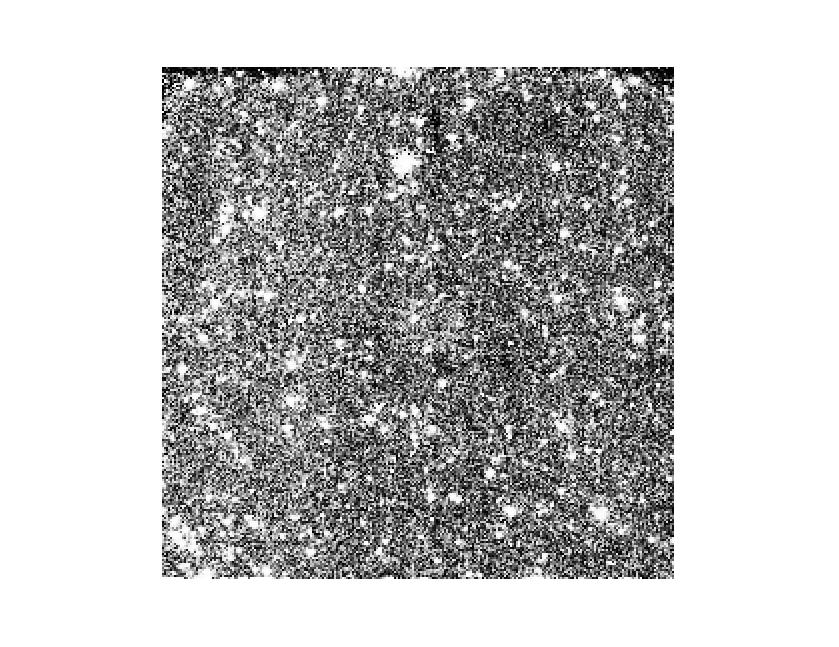
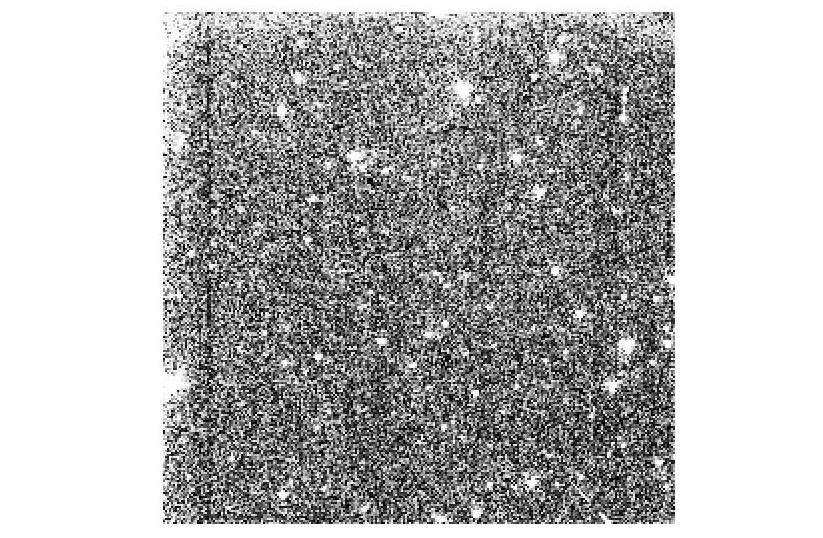
However, no such laboratory measurements exist for the warm instrument. As a result, there is currently no correction for the first-frame effect, and so some floating bias level is seen in the BCDs. For the warm mission, skydark suites are taken, reduced, and used in the same manner as in the cryogenic mission. Overall, a higher bias level is seen in the skydarks relative to cryo. In addition, clusters of bad pixels at 4.5 microns result in a series of artifacts (notably column pulldown) being present in every frame. Since they are in every frame taken, they are mostly removed during the sky-subtraction stage in the pipeline. Median counts of the bias frames have increased significantly from ~ 30 DN/s in cryogenic mission to ~ 100 DN/s in warm mission in channel 1, and from ~ 3 DN/s in cryogenic mission to ~ 12 DN/s in warm mission in channel 2.


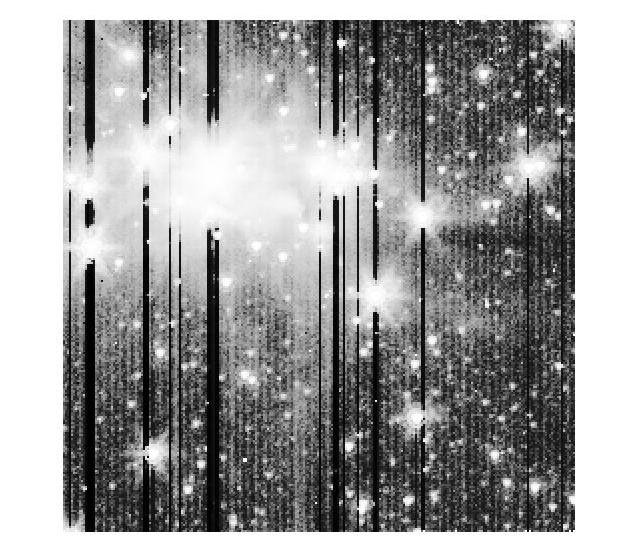
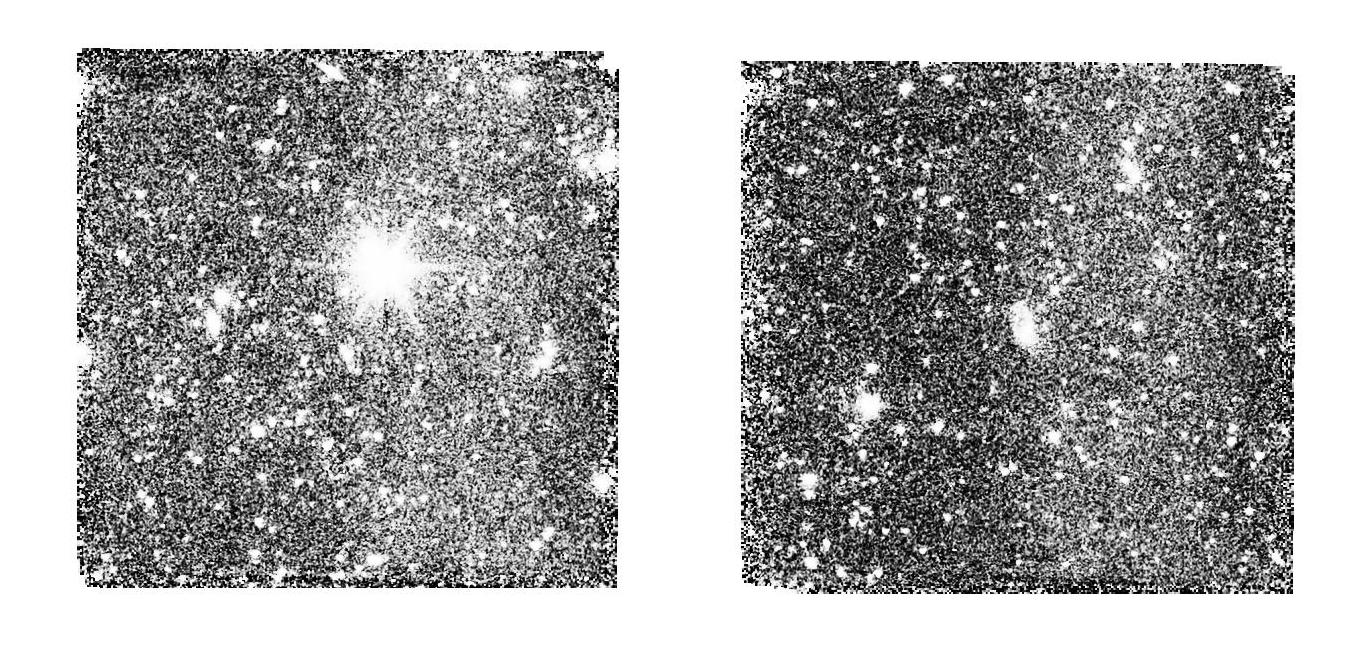
The above figure shows the IRAC 12 second skydark ensembles created in cryogenic mission (left) and during the warm mission characterization period (right). The column pulldown artifact is apparent in five columns of the 4.5 micron channel in the warm mission darks. Its strength is the same percentage of the background for all the frame times. The increased striping is a result of the more significant bias and not having a labdark subtracted.

6. IRAC Flat Fields

The pixel-to-pixel gain variations (commonly called the flatfield) were remeasured during IRAC Warm Instrument Characterization (IWIC) and again every two weeks during the regular warm mission. These measurements were made as during the cryogenic mission, using highly-dithered imaging of the brightest parts of the zodiacal cloud.

Overall, the flatfield has remained substantially unchanged relative to the cryogenic mission. There are, however, small gradients and other changes at the 1% - 3% level, so the two are not interchangeable. Similarly, the normalization of the flats has changed slightly, so for self-consistency the current flux calibration factors only apply to data processed with the new flats.

Data taken during IWIC and PC-1 through PC-4 are flattened using calibration data obtained during IWIC. The accuracy of the flat is 0.7% (1 sigma) at 3.6 microns and 0.3% at 4.5 microns. Data taken with the temperature floating (between August and September 2009) may have slightly degraded performance. However, given the very small differences in the flatfield between 15 K and 30 K, it is likely that the flatfield is still accurate to better than 1%. Data obtained on September 18, 2009 and later are flattened with data taken during PC-5. The accuracy of this flat is 0.3% (1 sigma) at 3.6 microns and 0.15% at 4.5 microns. The flat measurement for PC-5 and later data will continue to be updated as the mission continues.


A comparison between the flats derived during IWIC and the cryogenic flats. Large-scale variations at the level of a few percent are seen.

7. IRAC Linearity

The IRAC detectors have a non-linear response - the conversion from detected flux to data numbers is not a simple constant. In the cryogenic mission, this non-linearity was corrected based on ground calibration of the instrument using special test equipment, and was confirmed in-flight through numerous observations.

During IWIC, it was found that the non-linearity and well-depth varied as both a function of applied voltage on the arrays and the array temperature. Both of these have been changed as a result of warm operations. Unfortunately, it is extraordinarily difficult to recalibrate the linearization in-flight with the accuracy of the ground-based cryogenic linearization.

The linearity calibration has recently been derived using a combination of staring observations of bright galactic nebulae, and from the photometry of sources observed by the SERVS exploration science program, vs. the same sources observed by the SWIRE Legacy science program during cryogenic operations. The new linearity solution should be accurate at the level of better than 0.5%. The cryogenic calibration is still used for the period prior to September 18, 2009 while the new warm linearization is used for all data taken afterwards.

IWIC results indicate that the non-linearity at warm temperatures is more severe than at 15 K. Using the cryogenic calibration provides at least a partial correction. Note that the flux calibration is based on standard stars which are usually near 1/3-1/2 full well. Targets that are near this well-depth will always have correct fluxes. Warm data linearized with the cryogenic calibration in channel 1 will have a systematic error of roughly 2%-3%, such that brighter objects (those approaching the saturation limit near 30,000 DN) are systematically too faint. The effect is much smaller in channel 2, and is believed to be approximately 1%. In addition to bright objects being too faint, faint objects may appear slightly brighter than they actually are, although this effect will be at the 1% level or less.

The other change in the warm linearization is that the well-depth which is defined by the point at which the pixel DN peaks is now roughly 30,000 DN in both channels, whereas it was closer to 44,000 DN in the cryogenic mission. For data processed with the cryogenic calibration, the saturation flag should be considered unreliable. Users should examine the raw data numbers for sources that are suspected of being near saturation.

8. Persistent Images

Both IRAC channels have residual images of a source after it has been moved off a pixel. When a pixel is illuminated, a small fraction of the photoelectrons is trapped. The traps have characteristic decay rates, and can release a hole or electron that accumulates on the integrating node long after the illumination has ceased. The warm mission short-term residual images are different in character than the cryogenic residuals (for details on the cryogenic residual images, see Section 7.2.8 in the IRAC Instrument Handbook), as the behavior of the trap populations is a function of the impurity type and temperature. Typically for channel 1, warm residuals are <0.01% of the fluence of the source after 60 seconds. The residual image never exceeds 1% of the illuminating source for integrations beginning immediately after the illumination ends. Usually the residual will be orders of magnitude smaller, but the residual image of a star can persist as a false point source for up to several hours for the most saturating sources followed by low background deep observations. Channel 2 residual images decay much more rapidly than those in channel 1, lasting at most 10 minutes for the brightest sources.

For reference, the first figure below shows the residual decay for a strongly saturating first magnitude source observed in a 12 second integration time in channel 1. The data residuals are measured using aperture photometry of subsequent frames and the residuals are averaged over time. In this extreme example, the residual persists above the noise in the background for more than five hours after the residual is produced.


Residual image brightness decay as a function of time interval since exposure to a first magnitude source at 3.6 μm. The residual is compared to three times the noise in the sky background as measured in an equivalent aperture. The fitted exponential decay function is plotted as the dot-dashed line. These curves have been smoothed to mitigate flux jumps due to sources at the position of the original source in subsequent images.

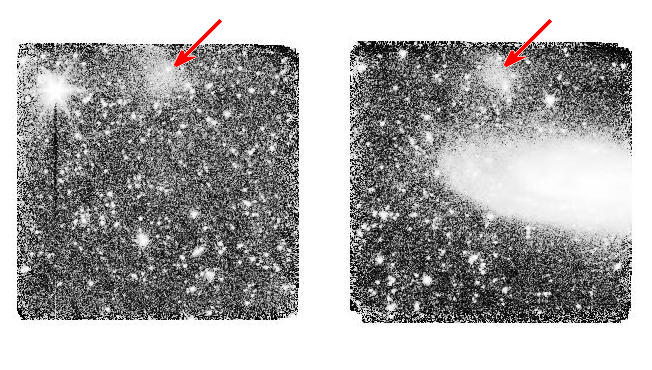
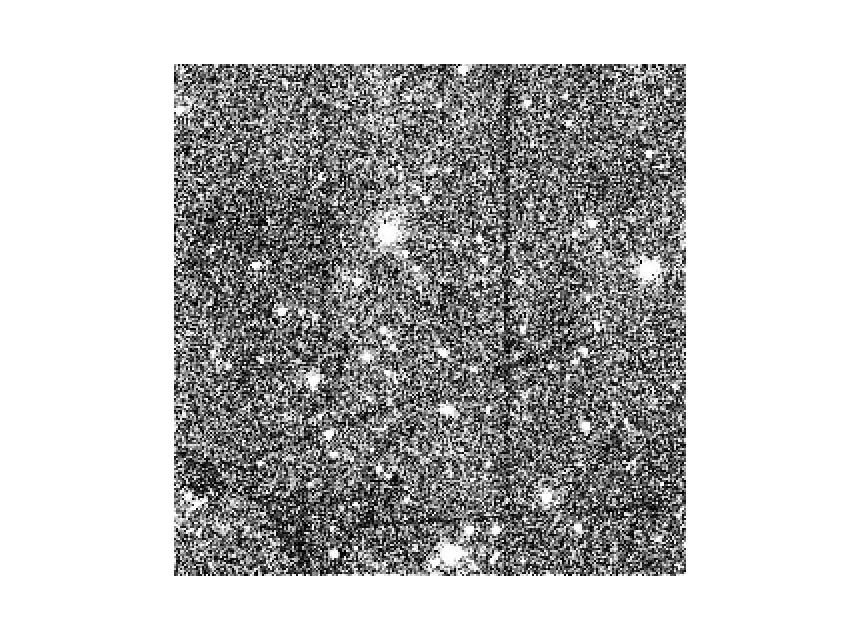
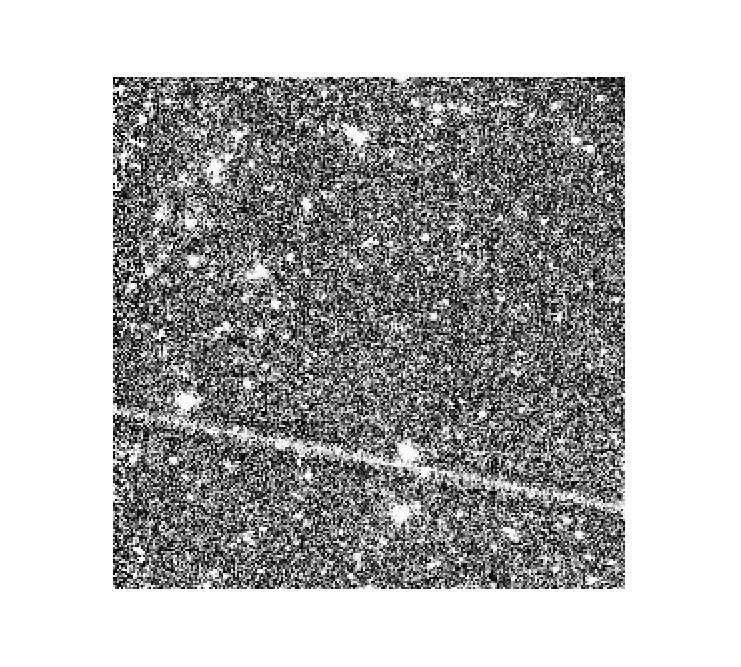
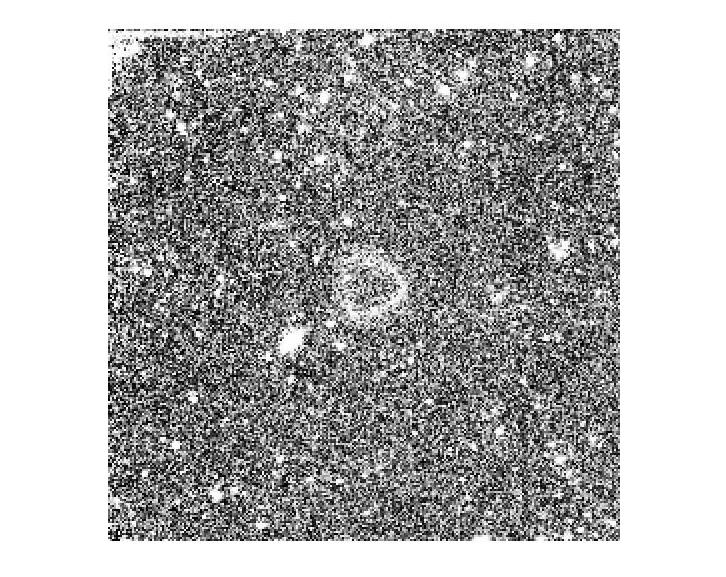
An example of the residual images for channel 1 is displayed in Figure 6.12 which displays the residuals produced by 3rd and 4th magnitude stars observed in a 12 second integration. In addition to the compact residuals, there are streaks that can be produced when bright sources cross the array during slews between AORs.


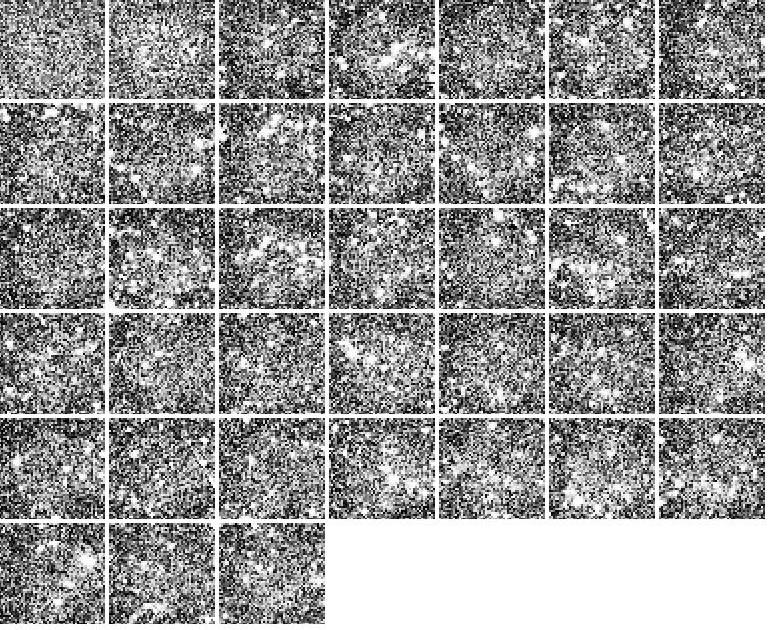
(From the Warm SOM, Figure 6.12): Illustration of residual images in warm data. 3rd and 4th K-magnitude stars were observed in a single 12 second frame (upper left panel). The upper right, lower left and lower right panels show the decay in the residual in 12 second frames taken 60, 120 and 180 seconds after the bright sources were observed. The positions of the bright sources on the array are identified by red annuli in subsequent frames. The linear features connecting to the bright residuals are from slews, produced as those bright sources move on and off the array. The dark patch above the 3rd K-magnitude star residual (leftmost residual) is a diffuse residual from a previous observation and the linear features crossing the entire array are slew residuals from bright sources crossing the array during earlier observations.

9. Muxbleed

The muxbleed artifact no longer occurs at the final warm array temperature. The correction has been turned off in the pipeline.

10. Column Pulldown

Column pulldown has been identified in the warm data, but is more severe; additionally there are several columns in channel 2 that are now permanently pulled down due to hot pixels. The level of the pulldown above and below the triggering source is different, and the pulldown decreases with distance from the trigger along the column. A new algorithm is currently being developed for the artifact correction part of the CBCD pipeline. Third order polynomial and exponential fits to the data appear to work well, although they are complicated when dealing with complex backgrounds. The triggering threshold in any given frametime is considerably smaller than in the cryogenic mission.

11. Saturation

The saturation level has changed slightly in the warm mission as a result of changes in well-depth and sensitivity. Additionally, users should be aware that for certain frametime/Fowler-number combinations the saturation values (in DN) differ significantly from the norm, and that the saturation value varies across the array. This effect is greatest for the shortest frametimes. In general, the highest saturation levels are near the bottom left corner (pixel 1,1). Note, however, that deliberately placing a specific target near a pixel corner rather than a pixel center is a much more effective strategy for coping with saturation than manipulating overall placement on the array. Using a pixel corner will increase the saturation level in the table below by factors of roughly 3-4. The table below gives the array-averaged saturation limits for a source centered on a pixel in each channel as a function of frametime.


Frame Time (sec) 3.6um sat (mJy) 4.5um sat (mJy)
100 2.8 3.5
30 10 12
12 25 30
6 50 60
2 160 200
0.6 500-700 600-900
0.4 900-1400 1000-1700
2 subarray 150 180
0.4 subarray 700 900
0.1 subarray 3000 3700
0.02 subarray 20000-26000 28000-35000

A more detailed discussion may be found here.

12. ABADDATA - Extra Pixel in Science Image

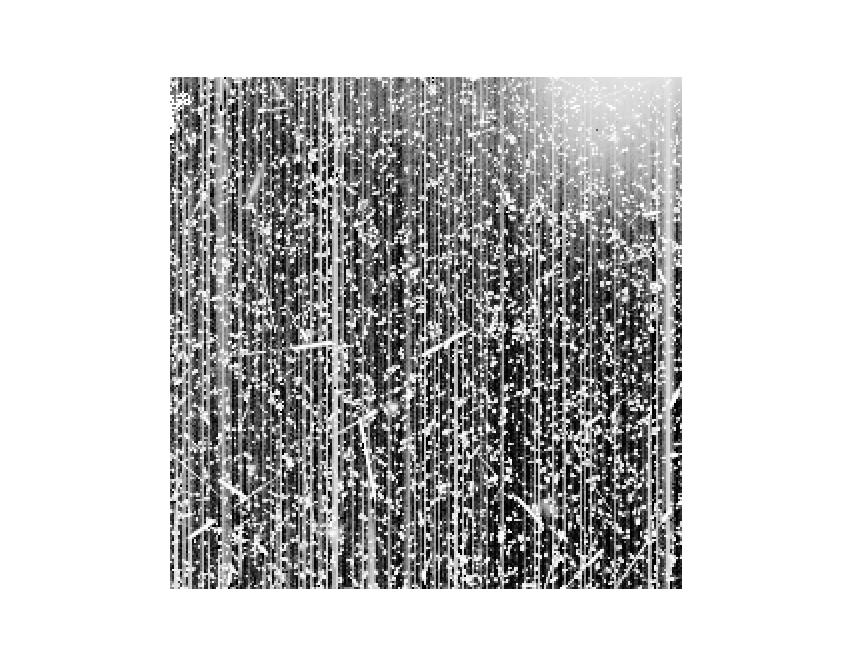
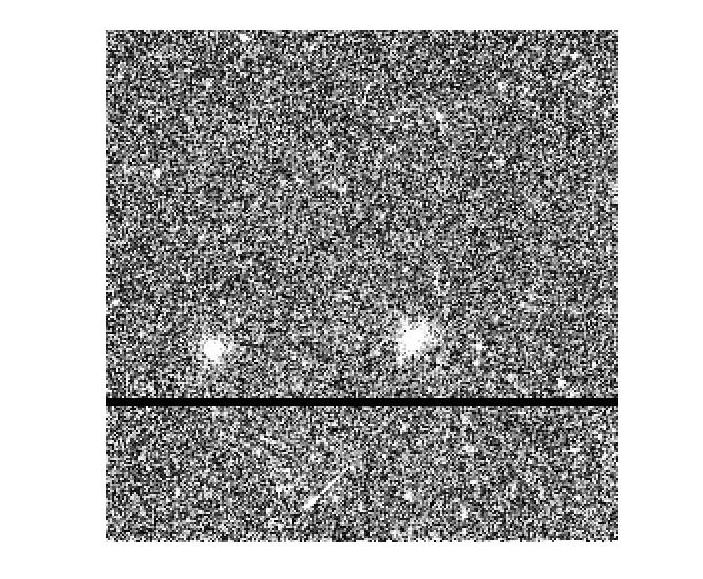
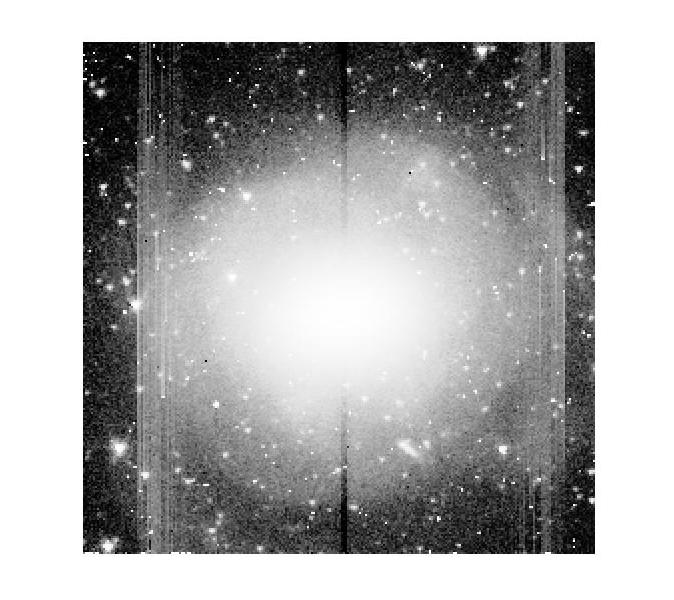
An occasional problem is observed during the warm mission wherein an extra byte appears in the science packet (image data). As a result, all pixels after this byte are shifted by one pixel. Such images are identified by having the ABADDATA header keyword set in the raw data (BADTRIG in the BCD images); the images themselves usually become stripy as a result of the mismatch between the science and calibration data. The latest version of the SSC pipeline corrects this by locating the first pixel in the image with a value of exactly 0, and then shifting all later pixels. This correction may fail if there are multiple zero-level pixels in the image.


Illustration of processed BCD with ABADDATA (left) and after correction (right).

13. Bad Pixels

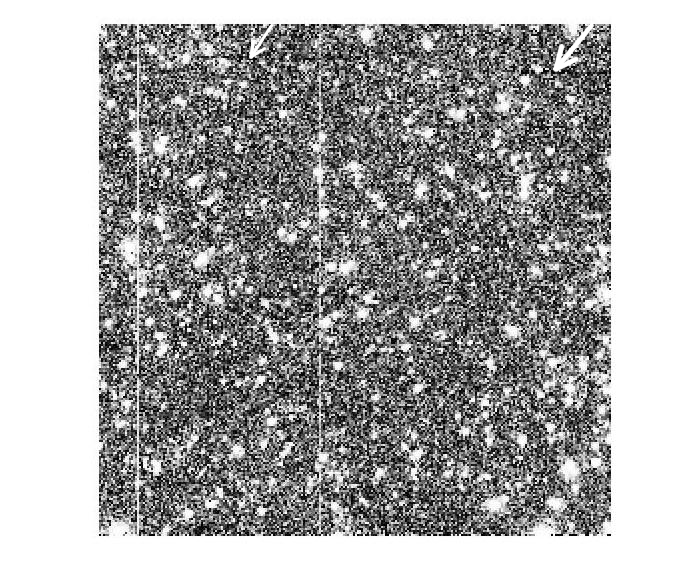
The location of the quasi-static bad pixels changed relative to the cryogenic mission. Quasi-static bad pixel masks for both the cryogenic and warm missions can be downloaded here.


Bad pixels in channel 1 (left) and channel 2 (right), in BCD orientation.

* Copyright Society of Photo-Optical Instrumentation Engineers. One print or electronic copy may be made for personal use only. Systematic reproduction and distribution, duplication of any material in this paper for a fee or for commercial purposes, or modification of the content of the paper are prohibited.

IPAC Caltech
Jet Propulsion Lab NASA