
Contents of page/chapter:
+Default Plot
+Plot Format: A First Look
+Plot Navigation
+Plot Linking
+Changing What is Plotted
+Plotting Manipulated Columns
+Restricting What is Plotted
+Overplotting
+Adding Plots
|
| This is a plot of positions of a list of EXES observations returned by a search on M42. |

| 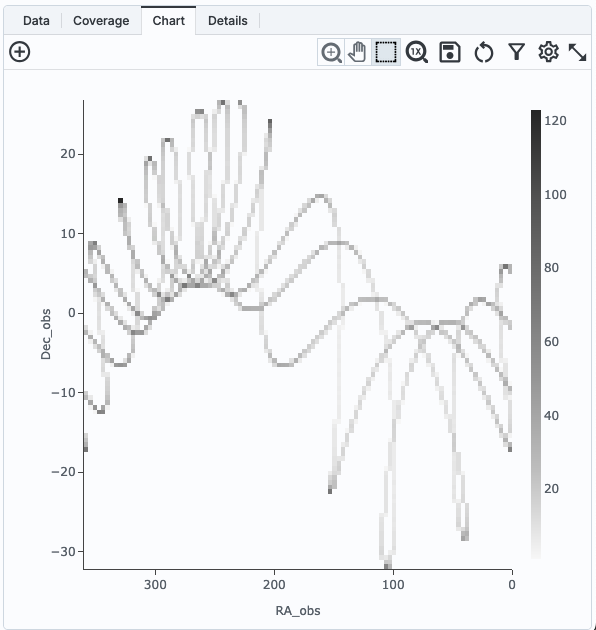 Positions of a list of images returned by a moving target search (left), and (right) the slightly more exciting plot of positions calculated for said moving target. |
You can change what is plotted (see below) but plots of image metadata may not be what is most desirable.
Try loading in a catalog and keep reading! The default plot for a catalog will also be RA and Dec.
Note that all of these RA/Dec plots follow astronomical convention -- RA increases to the left.
To obtain a full-screen view of your plot, click on the expand icon in
the upper right of the window pane:
 . To return to the prior view, click
the "Close" arrow in the upper left.
. To return to the prior view, click
the "Close" arrow in the upper left.


The difference between them is that, for larger catalogs (left), the plot is binned -- more points are encompassed in a black tile and fewer points are encompassed in a white tile. In the context of this tool, this is called a heatmap. The shades of grey correspond to how many points are encompassed in each 'cell', with the density scale given on the right hand side of the plot. For smaller catalogs (right), each individual point is shown as a blue dot. In the context of this tool, this is called a scatter plot. Note that even when individual points are shown, where the points overlap, the color is darker.
In either case, letting your mouse hover over a point tells you the
values of the point under your cursor, and (if binned) how many points
are represented:
 for binned
plots, and
for binned
plots, and
 for just one point.
 Clicking (in an unbinned
plot) highlights that point, and it stays highlighted, though you
must keep your mouse on the point in order to see the information
about it.
Clicking (in an unbinned
plot) highlights that point, and it stays highlighted, though you
must keep your mouse on the point in order to see the information
about it.
The reason the tool makes a heatmap for large catalogs is to more fairly represent the point density -- and to make the plotting faster. In these cases, though, it will not give you the option to overplot errors (see below). If you have a heatmap and want a scatter plot by default, you need to filter or otherwise restrict the catalog to have fewer points (see below). You can change the bin size and shading via the plot options pop-up (more on this below).
 which we now describe.
 Add new plot
 Plot mode
 Zoom mode
 .
.
 Pan mode
.
Pan mode
.
 Select mode
 The checkmark means
"select" and the funnel means "filter." The difference is that
filtering (temporarily) limits what is shown in the plot, catalog, and
image (see general information on
filters), and selecting just highlights the points enclosed within
your selection. To cancel either one, click on cancel filters
The checkmark means
"select" and the funnel means "filter." The difference is that
filtering (temporarily) limits what is shown in the plot, catalog, and
image (see general information on
filters), and selecting just highlights the points enclosed within
your selection. To cancel either one, click on cancel filters  or cancel selection
  .
.
Re-scale plot ⚠ Tips and Troubleshooting: Did you accidently zoom in the plot with your magic mouse or touchpad? Click on this icon to reset the plot.
 Save
plot
Save
plot
 Undo
Undo
 Filter from plot
 Configure plot
Expand plot
 Help
Help
.
Configuration options then appear; the options are a little different
depending on whether the points are binned or not. This section
describes how to change what is plotted, i.e., the "Modify Trace"
option at the top of both of these pop-ups. The overplotting option (and, for that matter, adding plots) are covered in more detail below.
 | This is the configuration window for a binned (a.k.a. heatmap and/or greyscale) plot. By default, the "chart options" may be hidden; to reveal them, click on the name "Chart Options" or the disclosure arrow on the right. To hide them again, click on the disclosure arrow on the right. |
 | 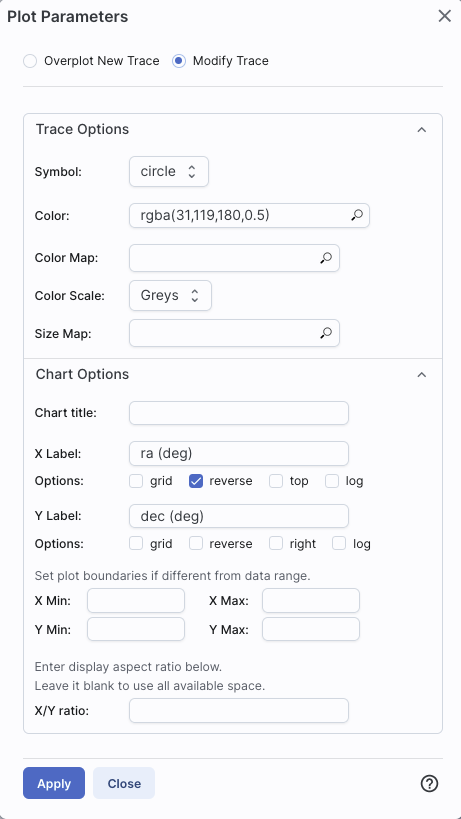 | The configuration window for a plot that shows individual points, once fully extended, is much longer (and scrollable), and so is shown here in two parts. Both the "Trace Options" and "Chart Options" may be hidden by default; to reveal them, click on the name or the disclosure arrow on the right. To hide them again, click on the disclosure arrow on the right. |
Click on the black triangle to reveal additional options.
In both of the examples above, RA is plotted on the x-axis. It has pulled the column name for the label; in this table, the column is "ra" rather than "RA", and it is case-sensitive. It has copied over the units ("deg") from the catalog, and plotted the x-axis increasing to the left as per astronomical convention. You can change what column is plotted, and whether or not errors are shown. Under "Chart Options", you can specify:
By default, the boundaries of the plot are set to encompass the full data range. Here you can change the boundaries to specific numbers. (This can also be set via filtering from the plot; see below.)
You can enter simple mathematical relations in these boxes too, such as (for a WISE catalog) "w1mpro-w4mpro" to put [W1]-[W4] on one axis. Supported operators:
Click "Apply" to apply, and "Close" to return to the plot without making changes. (For the latter, you can also click the 'x' in the upper right.)
Under "Trace Style," you can control whether the points are shown as individual points, connected points, or just lines connecting the points.
Under Trace Options, you have many choices.


Example: Load either a smaller WISE catalog, or the same large WISE catalog, but filter it down such that w1snr, w2snr, and w3snr are all greater than 10, which limits the number of points to be <5,000. Plot w1snr vs. w1mpro. It shows the points individually. Change the labels. Change the point color map to scale with w2mpro (WISE-2 profile fitted magnitude). Change the point size map to scale with w4snr (WISE-4 signal-to-noise). Obtain this plot:


For example, if you have loaded a WISE catalog, you can plot [W1]-[W2]
vs. [W3]-[W4]. In terms of the names of the columns in the database,
this is w1mpro-w2mpro vs. w3mpro-w4mpro. 
|

|
If you have few enough points that the plot is not binned, you can add
errors that you calculate. Here, the expression for the
x-axis errors is sqrt(power(w1sigmpro,2)+power(w2sigmpro,2)) and for
the y-axis errors, it is sqrt(power(w3sigmpro,2)+power(w4sigmpro,2))
-- that is, the errors for the individual photometric points added in
quadrature. 
|

|
You can filter the catalog from the table itself (discussed in another section).
You can set axis limits on the plot itself from the plot options pop-up (discussed above).
However, and perhaps more powerfully, you can set limits from the plot
itself using a rubber band zoom. Click on the select icon in the plot
Then, click and drag
in a sub-region of the plot. New icons appear: If you click on the
funnel icon, only those data points that pass the filter are shown in
the plot, in the table, and/or overlaid on the image(s). (This is the
behavior of 'filter', as opposed to 'select'; the former restricts
what is shown, the latter just highlights the points.) For more on
filters, see the filtering discussion in
the tables section.
Example: Obtain a WISE catalog of a star-forming
region, say IC1396. Filter down the catalog to only have detections at
all four WISE bands. (Limits have undefined errors, so ask the catalog
to filter down such that w1sigmpro>0, w2sigmpro>0,
w3sigmpro>0, and w4sigmpro>0). Plot w1mpro-w4mpro on the x-axis,
and w1mpro on the y-axis. Reverse the y-axis to put bright objects at
the top. Click and drag in the plot to select the bright and red
objects, and filter them down to get a subset of bright and red
sources. For clarity, the screenshot here has the sources selected,
not filtered.


 They are "Overplot New Trace" and "Modify Trace." Modifying traces
(plots) has been covered above; in this section, we will cover
overplotting. This is sometimes called "multi-trace," meaning that
more than one thing is plotted.
They are "Overplot New Trace" and "Modify Trace." Modifying traces
(plots) has been covered above; in this section, we will cover
overplotting. This is sometimes called "multi-trace," meaning that
more than one thing is plotted.
When you select "Overplot New Trace," you get a new interface that is
very similar to the original interface where you selected what to
plot:

As before, you need to :

|
The best way to explain how to use this feature is probably via an
example. We have a plot of [W1] vs. [W1-W4] from above. Now add on
top of it a plot of [W2] vs. [W1-W4]. Click on the gears to bring up
the pop-up. Select "Overplot New Trace." Enter "w1mpro-w4mpro" for x
and "w2mpro" for y. Expand "Chart Options." Note that it has preserved
the overall chart title from before, but has erased the X and Y labels
(and lost the reversal of the y axis) because the overplot could
literally be anything, and need not be the same columns or even the
same units as what is already plotted. Type them in again. Here is the
configuration window right before clicking "ok", and the resultant
plot. 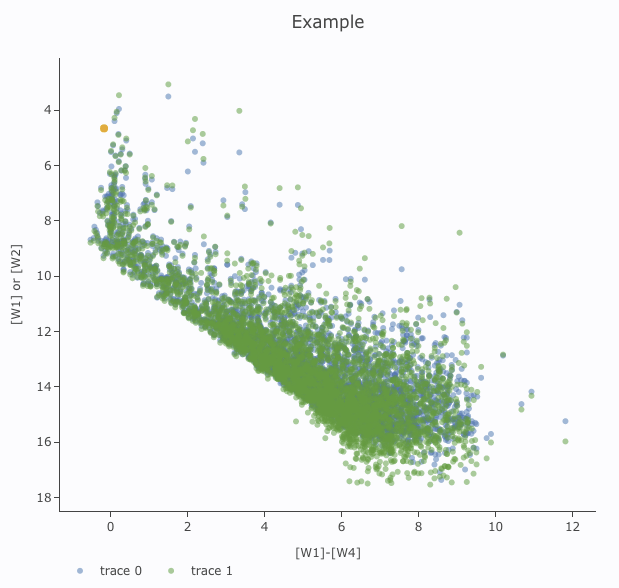
|

|
After you add the overplot, if you click on the gears again, note that
the choices at the top of the window have changed. You can add another
overplotted trace, modify a trace, or remove the active trace. Each
trace that you add is a new 'layer' on the plot. The drop-down menu
near the top of the window controls which trace is 'active' for
setting the x, y, errors, trace style, name, symbol, color, etc.
there is now a drop-down menu at the top of the plot: There is a
legend on the plot specifying which color corresponds to which trace.
In this example, the plot above has appeared using a blue and green
color scheme, which may be too hard to differentiate. To change the
new points' color, click on the gears, ensure "Modify Trace" is
selected, select "trace 1" (as opposed to "trace 0", the first one you
loaded), go down and expand the "Trace Options" and pick a different
color. You can also change the legend name from "Trace 1" to, in this
case, "[W2]". Click "apply" to apply the changes to the plot. Note
that once you change the trace name, the relevant drop-down menus in
the pop-up window and the legends on the plot update accordingly.
|
Note that the pop-up spawned by clicking the gears now has an additional
option at the top: "Add New Chart", "Overplot New Trace", "Modify
Trace", and "Remove Active Trace." From here, you can modify a trace
you have already plotted (as described above), overplot another trace
(also as described above), or remove the selected trace:

⚠ Tips and Troubleshooting
and try
again.
Clicking on this icon brings up a
dialog from which you can choose to make another scatter plot (left
below), a heatmap (center below), or a histogram (right below): 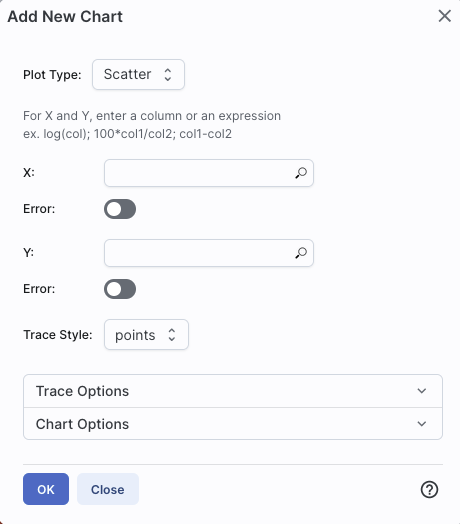


Scatter plots allow you to choose points, connected points, or lines; you can add errors to each point.
Heatmap plots are binned scatter plots; you can choose what color scale and how many bins to use.
Histogram plots allow you to choose how many bins or the bin width. Note that, if you provide a minimum number, the binning starts at the minimum value you provide, and may exceed the maximum you entered in order to fit in a whole bin.
You can change what is plotted after plotting by clicking on the gears, as described above.
You can have many plots up at the same time.
You can view multiple plots all at once or one at a time by clicking
on the corresponding icons above the plots (just as when you have
multiple images loaded).  The single
box means "one at a time", the set of four boxes means "all the plots
at once". If you are viewing one at a time and have more than one plot
loaded, you will see the ">" and "<" signs (as in the image
here), and you can scroll among the plots by clicking on these arrows
(just as when you have multiple images loaded).
The single
box means "one at a time", the set of four boxes means "all the plots
at once". If you are viewing one at a time and have more than one plot
loaded, you will see the ">" and "<" signs (as in the image
here), and you can scroll among the plots by clicking on these arrows
(just as when you have multiple images loaded).
⚠ Tips and Troubleshooting
