[an error occurred while processing this directive]
PREVIOUS START NEXT
Results Page
When processing is complete, the Results page will be displayed.
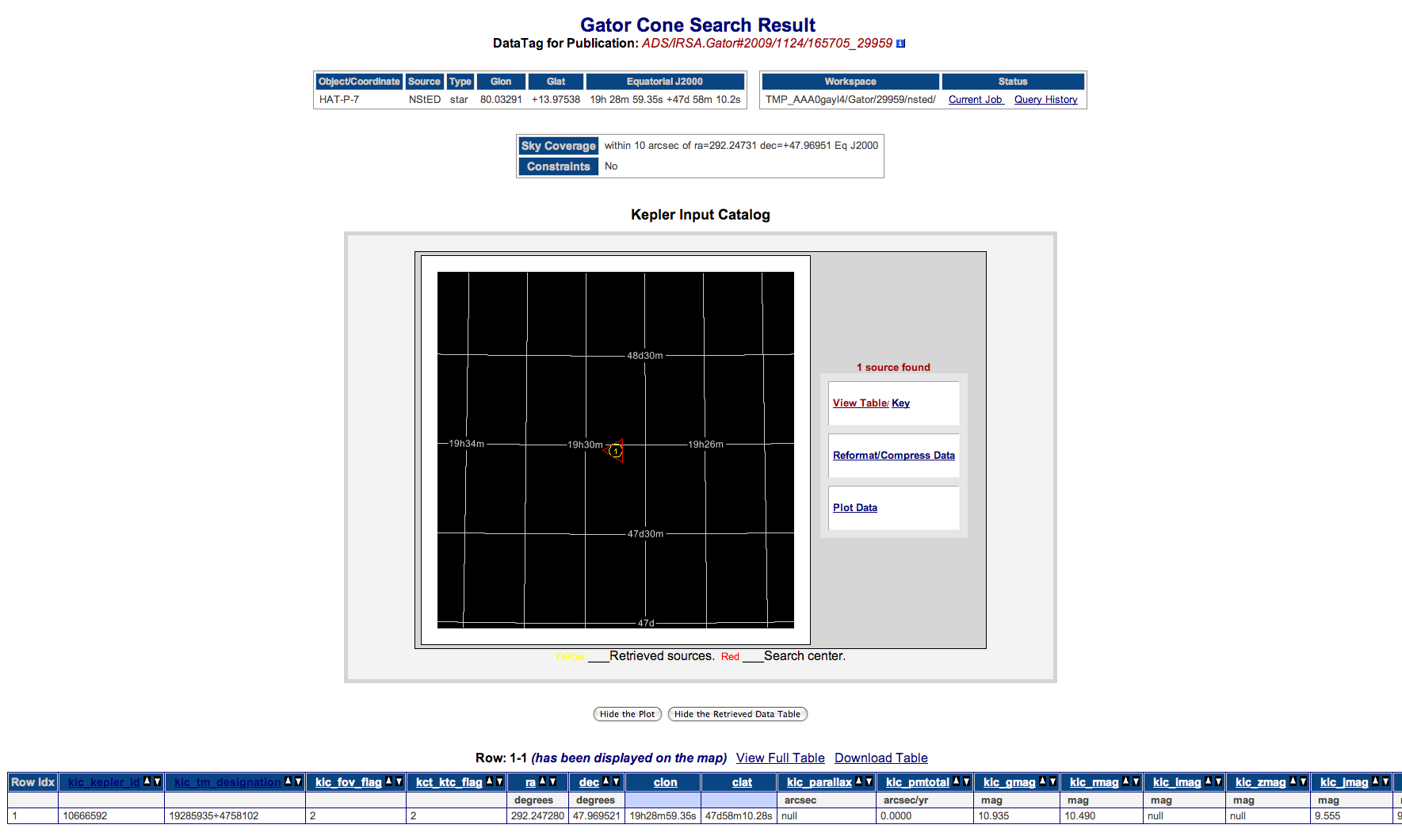
Descriptions of the various components of the Results page are as follows:
- Workspace / Status Table - This table contains the Object name or coodinates, the archive that resolved the name if used, Type, Galactic Longitude, Galactic Latitude, Equatorial J2000 right ascension and declination, name and path of the workspace used, and the Current Job and Query History hyperlinks.
- Table of Sky Coverage and Constraints - This table contains the location in the sky that you specified, as well as any constraints. Note that the right ascension and declination are expressed in different ways in the different tables. These values are equivalent.
- Results Display Map - This is a map with the location of your object(s).
- View Table - This link displays the table that was generated from your search and allows you to download the result table as an ASCII file. Note that only the constraints that had their Sel checkboxes selected will be shown in the Results table.
- Key - Displays a description of the columns.
- Reformat / Compress Data - This link allows you to reformat or compress your results.
- Plot Data - Use this link to plot your data.
- Hide the Plot button and Hide the Retrieved Data Table button - Use these buttons to hide portions of your results.
- Object Table - This table contains the row ID, longitude, latitude and any constraints that you specified by clicking on the Sel checkbox next to the constraint.
Object Table's Derived Columns for Every Spatial Catalog Search
- dist - The computed distance, in arcseconds, from the input position to the cataloged position of this source.
- angle - The computed angle, in degrees east of north, from the input position to the cataloged position of this source.
- clon - The computed ra (J2000 EQ) in sexagesimal.
- clat - The computed dec (J2000 EQ) in sexagesimal.
Derived Columns for Kepler Target Selection Catalog
A description of the derived columns for the Kepler Target Selection catalog can be found here.
PREVIOUS START NEXT