
- Equatorial (RA/Dec) J2000 in hh:mm:ss ddd:mm:ss format
- Equatorial (RA/Dec) J2000 in decimal degrees
- Galactic in decimal degrees
- Equatorial B1950
- Ecliptic J2000
- Ecliptic B1950
- FITS Image Pixel
- Zero-based Image Pixel
All of the interactive image visualization tools work the same basic way, and here we describe these basic options, in roughly the order in which you might encounter them in the window.
Critical to many of the functions described in this visualization section is the concept of the "selected image." Finder Chart can return up to 34 images of the same patch of sky. Look at the array of images returned by a search. One (you may have to look for it) is "selected" -- it is outlined in brown. Click on a different image, and that image becomes outlined in brown as the selected image. By default, the Finder Chart images are locked together, so quite often what you do to one image is done to all the images. But certain other behaviors described here are still customized to each individual image. In order to affect a given image, you must select it.
Contents of page/chapter:
+FITS Viewer
+Image Information
+Breaking Out of the Pane (and Going Back)
+Image Navigation
+Image Toolbar
+Color Stretches
+Image Layers: Viewing/Changing the Layers on the Image
+3-color images
+Extraction Tools
+Region Selection
+Footprints
+Examples of Catalogs and Layers

You can change the units of what is being read out, in terms of
coordinates or pixel values.
| If you click on the label of the coordinates,
"EQ-J2000" in the screenshot example above, you get this pop-up, from
which you can choose the coordinates from among:
|
 | Click on the label of the readout, "Flux" in the tiny
snippet of a screenshot example above, and you get this pop-up, from
which you can choose the pixel readout from among:
 is a
conversion tool between decimal and hex.) is a
conversion tool between decimal and hex.)
|
In the lower left of the images, if you click on this:  , you get this pop-up. At the top of this pop-up,
it shows the whole image; the orientation of the image is given with a
compass rose. There is also a zoom-in of the image at the location
under your cursor. Underneath that in the pop-up, you can get a
readout of the pixel size, a readout of location on the image in two
different coordinate systems, and a readout of the pixel value. You
can change the units of those values by clicking on the name of the
field: "Pixel Size", "EQ-J2000", "Image Pixel", and "Value". Each
results in a pop-up, as above. , you get this pop-up. At the top of this pop-up,
it shows the whole image; the orientation of the image is given with a
compass rose. There is also a zoom-in of the image at the location
under your cursor. Underneath that in the pop-up, you can get a
readout of the pixel size, a readout of location on the image in two
different coordinate systems, and a readout of the pixel value. You
can change the units of those values by clicking on the name of the
field: "Pixel Size", "EQ-J2000", "Image Pixel", and "Value". Each
results in a pop-up, as above.
|

|
You can make the cursor 'stick' on a particular place on the image --
flip the "Click Lock: off" switch to "on" (either in the pop-up or in
the lower right of the image window), and then click on the image at
your desired location. When this is clicked, small "clipboards" appear
near the position readout. Click on that icon to copy that position to
your clipboard.

 Example of image label. Note that it
contains information about the survey, band, date obtained, and
current field of view ("FOV").
Example of image label. Note that it
contains information about the survey, band, date obtained, and
current field of view ("FOV").
 | The target on which you searched is overlaid on the main image with a cross-hair marker, sometimes called a "reticle." You can remove this (or change its color) from the layers pop-up, described below. |
Make it big! For some purposes, it is useful to
individually view just the table, or the images, or the plots, as
large as possible. In any pane, this icon  appears in the upper right of the pane.
Clicking on it will expand the pane into a larger window, as big as
possible given your browser size.
appears in the upper right of the pane.
Clicking on it will expand the pane into a larger window, as big as
possible given your browser size.
Go back the way it was:  The
large "Close" arrow at the upper left is always available in the
expanded views, and enables you to return back to the pane view.
The
large "Close" arrow at the upper left is always available in the
expanded views, and enables you to return back to the pane view.
Special case of images only: If you have only images loaded in, then the images are taking up all of your browser window, and it is already, by default, in this expanded mode. There's no 'close' arrow in the upper left since there is nothing else loaded in. You can, however, view one image at a time -- see next section on image navigation.
 that portray (in icon form) the
different views you can have of the images you have loaded. The first
icon (the big square) denotes "show one image at a time." The second
icon (the cluster of four squares) denotes "show smaller images of all
the images I have loaded at once," e.g., tiled images. Whether the
images (tiled or not) take up all the space or not depends on whether
you are viewing in panes or in the full-screen mode (see immediately
above on Breaking out of the pane).
that portray (in icon form) the
different views you can have of the images you have loaded. The first
icon (the big square) denotes "show one image at a time." The second
icon (the cluster of four squares) denotes "show smaller images of all
the images I have loaded at once," e.g., tiled images. Whether the
images (tiled or not) take up all the space or not depends on whether
you are viewing in panes or in the full-screen mode (see immediately
above on Breaking out of the pane).

⚠ Tips and Troubleshooting: If your mouse is in a currently active (selected) image (that is, highlighted in brown), then your image will zoom rather than scroll. Just move your mouse over to another image, and then your window will scroll rather than zoom. Or, find your scrollbar.
This is the image toolbox when you have clicked on a FITS image you
have loaded:

Many of the icons have a downward pointing black triangle, which means
that there are additional options in a drop-down menu that appear when
you click on the icon.
We now discuss each icon in the order in which they appear.
 Tools drop down
 |
|
 Saving the image . Note that you control where the
file is saved on your disk through your browser; your browser may be
configured to store all downloads in a particular location on your
disk.
Saving the image . Note that you control where the
file is saved on your disk through your browser; your browser may be
configured to store all downloads in a particular location on your
disk.
You can save images as FITS, PNG, or regions files to your local disk.
Saved FITS images will not save the color stretches or overlays; it
will just save the underlying FITS image. Saved PNG files WILL
include the image as shown with any overlays or annotations you have
placed on the image, but will not include the underlying FITS image.
Saved regions files will not save the underlying image, but will just
save the overlays as a DS9 Regions file. See the DS9
website for more
information on the syntax of these DS9 region files.
Note that you can save the original or a cropped version of a FITS
file; see the "select region" icon below to crop, then click on the
save icon. Be sure to save the cropped FITS image (see annotated
figure).

Note that if you overlay a large catalog on an image, then turn around and save a regions file from the catalog overlay, the full catalog may not be saved to the regions file. If you have >5,000 sources, it's entirely likely that not every source will be overlaid on the image (because of hierarchical catalogs display), and thus will not be in the regions file. If you want to save your entire catalog as a regions file, save the catalog from the table pane.
The saved PNG is the same size as it is on your screen. If you want a big version, make the desired image big on your screen (view one-at-a-time; see here) before saving the PNG.
 Restoring everything to the
defaults
Restoring everything to the
defaults
 Viewing the image header


 Rotating the image so that North is
up
Rotating the image so that North is
up
 Flipping the image on the y-axis
 Add a coordinate grid
 that appears
next to the image toolbar, or click on this icon a second time to remove
the distance tool. (You can also remove this layer via the layers
icon.) for more
information on the syntax of these DS9 region files. The supported
regions are text, circle, box, polygon, line, and annulus. To make
this window go away without doing anything, click on the 'x' in the
upper right of the pop-up.
that appears
next to the image toolbar, or click on this icon a second time to remove
the distance tool. (You can also remove this layer via the layers
icon.) for more
information on the syntax of these DS9 region files. The supported
regions are text, circle, box, polygon, line, and annulus. To make
this window go away without doing anything, click on the 'x' in the
upper right of the pop-up. ⚠ Tips and Troubleshooting: If you overlay a list of sources you created in ds9 regions format from your disk, it will only be overlaid on the current image, not all of the images you have loaded. If you want to have it overlaid on all the images you have loaded, create a catalog from your source list and overlay it as a catalog. Then it will appear on all of the images you have loaded, provided that the positions overlap on the sky.
 Put a marker on the image
 .
The dash-dot line around it means that it is 'active', so you can move
(click and drag the marker) or resize it (click and drag the dash-dot
boundary). You can change the color of the marker (and change the
label) via the "layers" icon (described below). You can also remove
this layer via the layers icon. There are several additional options
in the drop-down, enough that they have their own section below.
.
The dash-dot line around it means that it is 'active', so you can move
(click and drag the marker) or resize it (click and drag the dash-dot
boundary). You can change the color of the marker (and change the
label) via the "layers" icon (described below). You can also remove
this layer via the layers icon. There are several additional options
in the drop-down, enough that they have their own section below.
 Draw a line in the image
 Make points in the image
 Zoom
Zoom
 Zooming in or out
If you click zoom in or out rapidly, a pop-up window appears to allow
you to more rapidly select the zoom level (field of view) you want.
Select the desired level, or click on the 'x' in the upper right to
make the window go away. Here is an example: 
You can alternatively zoom using the mouse wheel (or drag forward and backward on a touchpad or magic mouse).
Note that there is a maximum (or minimum) allowed zoom level. A notification will appear when you have reached the maximum (or minimum) allowed zoom level for a given image. To enlarge images more (or less) than that, please repeat your search to obtain new images with smaller (or larger) spatial extent.
 Fit image to screen or fill
screen
Fit image to screen or fill
screen
By default, the images that are returned are frequently but not always centered on your search target. Clicking on these icons let you see the whole image that is returned, whether or not it is centered on your target.
 Zooming to a 1-to-1 size
 Color table drop down
 |
|
 Color stretch drop down
 Re-center the image drop down

 Selecting a region drop down
 Image Layers: Viewing/Changing the
Layers on the Image
Image Layers: Viewing/Changing the
Layers on the Image

 Lock/unlock images

 Getting help
This icon enables you to change the color
stretch of the displayed image. (This option is only available for
FITS, not HiPS, images.) When you click the button, a drop-down menu
appears with a variety of choices.
 | The top of the menu either says "Color and overlays locked" or "Color and overlays unlocked" -- by default, all of the (FITS) images that you have loaded are locked together for color and overlays. What that means is if you change the color stretch (via this menu), then the color stretch for all the (FITS) images are changed. (Or, if you add a layer to one image, or change the color table of one image, then the change is made to all the images; see other sections of this chapter.) If you don't want this to happen, select "Color and overlays locked" to unlock it. Select the text again to lock it again. |

Example: Display the pop-up for color stretch. From the main drop-down, pick 'Linear stretch to 99%'. Go back to the color stretch pop-up. Note that it has filled out the stretch type and ranges to reflect the current choice. Then -- either with the pop-up window still up or not -- go back and pick a different pre-defined stretch from the standard options. Note that the values in the pop-up change to reflect this current choice. From the pop-up, pick a different stretch type -- try "histogram equalization." Select "refresh" to update the images. Go back to the drop-down menu. The last 7 items have changed to be based on histogram equalization, as opposed to the "linear" default.
If you have a 3-color image, you can change the stretch in each color plane separately; select the tab at the top accordingly for red, green, or blue. By default, it stretches each band independently, and you can set the parameters in the stretch pop-up accordingly.

As described in Lupton et al. (2004) , a different algorithm may be useful for creating
3-band color images. Select "Hue preserving stretch" to invoke this
option. This stretch should be a brightness-independent
color-preserving asinh stretch, though in practical terms, it seems to
work best for optical images.

It may be useful to scale individual channels; sliders allow you to do so. The Q parameter has another slider. For a linear stretch, Q=0; increase Q to change what features are emphasized. Pedestal values can also be set to allow the level assigned to "black" to change.
The number that appears circled in blue
over the layers icon tells you at any given time how many layers you
have on the currently selected image (the image outlined in brown).
If you click this layers icon, you will get a pop-up
window with a list of all the layers you have on top of the image.
Here (on the right) is an example of a well-populated layers pop-up;
in real life, this is scrollable to see several more layers). From
this pop-up, you can:
You can "show all" or "hide all" with the buttons on the lower left of the pop-up window. To make this pop-up window go away, click on the 'x' in the upper right of the pop-up.
Note the target description: |  |
| Finder Chart has slightly more complicated layers -- because the nature of the tool means that it often has results from more than one survey, you have different layers that are shown by default on each survey. Here is an example of a layers pop-up. The active image is a 2MASS image, so the current row is 2MASS. I have the option of turning on the artifacts (glints and persistence), but they're turned off here. The WISE catalog is there in a layer, but not shown on the current row (2MASS). The 2MASS catalog is there, but shown only on the current row (2MASS). My search position is shown on all images. (There are more rows, not shown, corresponding to other surveys.) I can change which catalogs are shown on which images from this pop-up. |  |
| Where it's possible to change colors of a
layer, click on the 'colors' link to be taken to a new pop-up from
which you can select a new color. From here, you can click on your desired color in the top colorful box. Immediately below that box, you can change the color and saturation of the top box so that you can select from a different range of colors. Below that, you can enter numerical hex codes or RGBA values (where the value for RGB is between 0 and 255, and A is in units of percent, e.g., 50 = 50%). Finally, you can also select from a pre-defined set of 15 colors by clicking on any of the small boxes. Note that the numerical codes update as you select different colors. Your choices are implemented as soon as you select them. Click 'Close' to close the window, or click 'x' in the upper right. If you have a catalog loaded into the tool, you can also obtain this pop-up by clicking on the color swatch in the heading of the catalog tab.
|
 |
| For catalogs or the search target, you can
also select the symbol shape and size. To adjust the size, type in the
symbol size in pixels or use the up/down arrow keys to change the size
by one pixel at a time. Your choices are implemented as soon as you
select them. Click 'Close' to close the window, or click 'x' in the
upper right.
|
 |
The images window pane consists of rows of images grouped by survey.
Near the top of the images window pane, you can find this icon:
 . If you click on this icon, at the end
of each row, a 3-color image appears that has been created out of the
bands going into that survey. Here is an example for HL Tau:
. If you click on this icon, at the end
of each row, a 3-color image appears that has been created out of the
bands going into that survey. Here is an example for HL Tau:

At the end of each set of survey images is a new, 3-color image. This
image has been automatically generated with pre-selected bands as the
color planes:
| survey | red | green | blue |
|---|---|---|---|
| DSS | DSS 2 IR | DSS 1 red | DSS 1 Blue |
| SDSS | z | g | u |
| 2MASS | K | H | J |
| WISE | W4 | W2 | W1 |
| Spitzer/SEIP | I3 | I2 | I1 |
| AKARI | WideL (140 um) | WideS (90 um) | n60 (65 um) |
| IRAS | IRAS-100 | IRAS-25 | IRAS-12 |
The "3-color" button is "sticky" in that if you turn it on, and then do another search, the new search will automatically make 3-color images.
⚠ Tips and Troubleshooting:
 -- Extract down through image planes
-- Extract a line from the image
-- Extract points from the image
-- Extract down through image planes
-- Extract a line from the image
-- Extract points from the image
Here, we cover the basic approach, with specifics of each tool integrated as we go along.
Intitiate extraction mode.
When you click on one of these icons, you enter into the extraction
mode. Text appears next to the image toolbar to remind you that
you are in this mode:  When you are
done, to end this mode, click on this "end extraction."
When you are
done, to end this mode, click on this "end extraction."
When starting out, the pop-up window that you get depends on the tool you pick.
| For the drill: | for the line: | and for the points: |  |
 |
 |
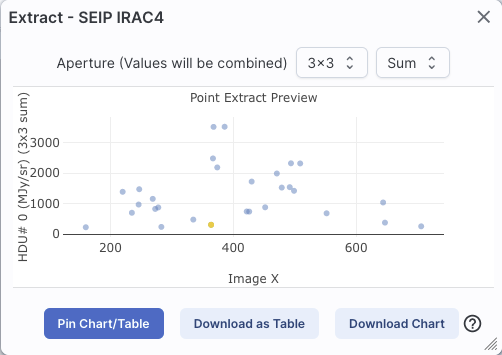
Try extraction. From this point, you can click on your image, or click and drag for the line tool. The pop-up then contains a plot of your extraction.
| For the drill: | for the line: | and for the points: |  |
 |
 |
Note that for the line, if you have more than one image loaded and visible, you can shift-click on a new image to see the same line on a new image. Similarly, for the points, you can shift-click to change images without extracting points. For the line extraction, if you want to change at this point to extraction along a line or column, use the drop-down menu at the bottom of the pop-up (shown here as "free hand selection").
Pin extraction. Once you have an extraction that you like, you can retain the extraction for further analysis. "Pin chart/table" extracts the information as a table, just like any of the other tables in this tool, with an accompanying plot. You can then manipulate the table/plot just like any other table or plot in this tool. If the tool recognizes the extraction as a spectrum, you may have additional capabilities.
Once you pin or save your extraction, the tool leaves a "footprint" of
your extraction on the image so that you can remember what the
extraction was. NOTE THAT it is not interpolating
across fractional pixels here. It is averaging if you have asked it to
average, but particularly if your pixels are
large, if you draw a line that is diagonally across pixels, it will be
immediately obvious that it's not interpolating. This line gets
rendered as these pixels:

The point appears on the image at the lower left corner of the
relevant pixel.
You can pin as many different extractions as you want.
From the line extraction pop-up, when you click on "Pin Chart/Table",
you get another pop-up:

From this pop-up, you can choose to do a line extraction from just the
currently selected image (most likely where you drew your line); all
the images and putting all of the extracted lines into one big table
(and tab); or all the images and putting all of the extracted lines
into individual tables (and tabs). When you do this, the question
naturally arises as to how the tool should specify which column (or
tab) goes with which image. Some of the images have long, sometimes
cryptic titles. You can choose to have the tool use the full image
titles in the column headers or tab titles, or abbreviations.
If you choose to have the tool generate one table for each image you have loaded, you may suddenly have a lot of new tabs at the bottom of the screen. There are navigation aids within the tables section that may help.
Download extraction. You can download the extraction as a table or plot without pinning it. Download as Table saves the table to your local disk -- first, you have the same options as immediately above, where you can choose to do a line extraction from just the currently selected image; all the images and putting all of the extracted lines into one big table; or all the images and putting all of the extracted lines into individual tables. Then you have all the same save options as a regular table. Download Chart saves the plot as shown, as a png file.
After pinning an extraction, you also have the extraction appearing as a table in the tables section of your window and as a plot in the plots section of your window. As with any table in this tool, you can save the table by clicking on the diskette icon in the table. You can choose from a variety of formats; see the tables chapter for more information. Similarly, as with any plot in this tool, you can save the plot by clicking on the diskette icon in the plot. See the plots chapter for more information.
Repeat extraction. As long as the extraction pop-up is still open, you can continue to click points or draw lines to make additional extractions.
End extraction mode.
When you are done, to end the extraction, click on "end extraction" to
end the extraction. Alternatively, just click on the 'x' in the upper
right corner of the extraction pop-up.
Advanced capabilities If you have a complicated
multi-extension FITS file with HDUs that are labeled things like
image, uncertainty, variance, flags, etc. (which is very unlikely to
happen in Finder Chart), you have some additional
options for extraction. When you pin the extraction, you can specify
an aperture larger than 1x1, which then begs the question of how the
pixel values are combined. When you have information that the tool
recognizes, and when you choose a larger aperture, you then get an
additional pulldown from which you can choose how the pixels are
combined: average, sum, or even logical "OR", depending on the
data:

When you click this icon, you can
select a region of the image, from which then you can do a whole host
of things to the image and to the catalog you may have overlaid upon
it.
| First, from the drop-down, you are given a choice of a rectangular selection or an elliptical selection: |
 |
When you have selected a region of the image, additional icons appear
above the image, and exactly which icons you see is a function of
whether or not you have a catalog overlaid:  These icons allow you to do several
things:
These icons allow you to do several
things:
 Crop the image
Note that, if you have a rotated FITS image such that
a crop would have to bisect pixels, it will show you the region that
encompasses your selection. If you crop at that point, then, it will
crop in image space (such that pixels are not bisected). See the
figure below -- in the original image, north is up. This has been
rotated 45 degrees. The selected region is in white. The yellow
dash-dot line is the crop in pixel space that encompasses the selected
region.


 Select sources (and cancel
selection)
Select sources (and cancel
selection)
 Filter sources
 ). To clear the filters, click on the
cancel filters icon (which also appears after you impose filters):
). To clear the filters, click on the
cancel filters icon (which also appears after you impose filters):
 . There is much more on filters in the Tables section.
 Zoom the image
 Recenter the image
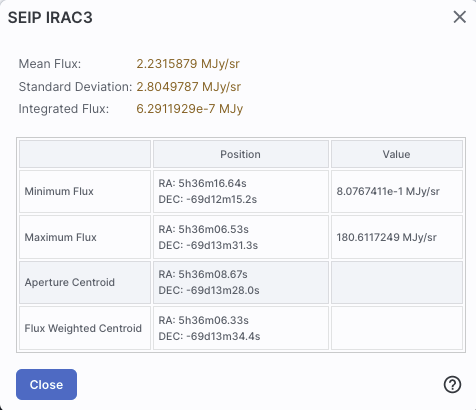
 Obtain statistics
 Search
This tool implements a new search, an "action", on
the region you have selected. It results in this drop-down (right).
where this example is based on a region centered on 210.807785m
54.344223, J2000 decimal degrees, over a 4-cornered polygon. (You can
also use the region tool to define a cone; this example happends to be
a rectangle.)
From this drop-down, you can launch:
|
 |

 appears next to the image toolbar
to remind you that you are in that mode. If you are refinifng
positions for a search, it will be
appears next to the image toolbar
to remind you that you are in that mode. If you are refinifng
positions for a search, it will be  . Either way, when you are done with the selection tool,
if your other actions don't turn off the selection tool, click on that
text to turn it off.
. Either way, when you are done with the selection tool,
if your other actions don't turn off the selection tool, click on that
text to turn it off.⚠ Tips and Troubleshooting
) has a drop-down menu with
several possible options:
For each of these choices, the markers appear initially in the center of the loaded images. The first mouse click you make in any of the images will move the marker to that location.
Each of these marker choices, when overlaid and/or selected as
'active', has a dot-dash square around it. If it is asymmetrical (most
of them are), it has an additional "appendage" and a red plus at the
center of the footprint:

These so-called "handles" allow you to resize and/or rotate the
marker, depending on the nature of the marker. These handles only
appear when the marker is selected as active; if you wait a few
seconds, they vanish.
⚠ Tips and Troubleshooting
The first overlay choice (simply
called 'marker') is a red circle.
The remaining markers are all footprints from various telescopes:
Spitzer, SOFIA, HST, JWST, and Roman. HST, JWST and Roman are derived
from information provided via MAST (see http://gsss.stsci.edu/webservices/footprints/help.html
.) For Roman in
particular, they are pre-launch values.
 Spitzer/IRAC 3.6 and 4.5 micron
footprints. These two footprints are placed separately
from each other. The footprint can be moved or rotated. Click and drag
the center of the footprint. A circle appears with four small circles
("handles") around it. Grab and drag the small circles to rotate it,
or drag the big circle to move it. Change the color, delete, or add
more copies of the IRAC footprints from the layers pop-up.
Spitzer/IRAC 3.6 and 4.5 micron
footprints. These two footprints are placed separately
from each other. The footprint can be moved or rotated. Click and drag
the center of the footprint. A circle appears with four small circles
("handles") around it. Grab and drag the small circles to rotate it,
or drag the big circle to move it. Change the color, delete, or add
more copies of the IRAC footprints from the layers pop-up.
 SOFIA footprints.
Several different SOFIA footprints are available; the graphic here
shows a selection of them. The available footprints (all of which are
placed separately) are:
SOFIA footprints.
Several different SOFIA footprints are available; the graphic here
shows a selection of them. The available footprints (all of which are
placed separately) are:
 HST footprints.
You can overlay the whole focal plane footprint, shown here, or
individual instrument footprints (NICMOS, WFPC2, ACS/WFC, ACS/HRC,
ACS/SBC, WFC3/UVIS, and WFC3/IR). Consult the HST documentation for specifics on which apertures are which. The
footprint can be moved or rotated. Click and drag the center of the
footprint. A circle appears with four small circles ("handles") around
it. Grab and drag the small circles to rotate it, or drag the big
circle to move it. Note that if you overlay the
footprint on a very small image, nothing will appear to have happened.
You need at least a 45 arcmin image to comfortably see the footprint.
Change the color, delete, or add more copies of the HST footprints from
the layers pop-up.
HST footprints.
You can overlay the whole focal plane footprint, shown here, or
individual instrument footprints (NICMOS, WFPC2, ACS/WFC, ACS/HRC,
ACS/SBC, WFC3/UVIS, and WFC3/IR). Consult the HST documentation for specifics on which apertures are which. The
footprint can be moved or rotated. Click and drag the center of the
footprint. A circle appears with four small circles ("handles") around
it. Grab and drag the small circles to rotate it, or drag the big
circle to move it. Note that if you overlay the
footprint on a very small image, nothing will appear to have happened.
You need at least a 45 arcmin image to comfortably see the footprint.
Change the color, delete, or add more copies of the HST footprints from
the layers pop-up.
 JWST footprints.
You can overlay the whole focal plane footprint, shown here, or
individual instrument footprints (FGS, MIRI, NIRCAM, NIS, and NIRSPEC).
Note that if you overlay the footprint on a very
small image, nothing will appear to have happened. You need at least a
30 arcmin image to comfortably see the entire JWST focal plane. Please
consult the JWST
documentation for details
about the footprints. In all cases, if the footprint is 'active', a
circle near the middle of the footprint will appear with four small
circles ("handles") around it. Grab and drag the small circles to
rotate it, or drag the big circle to move it. Change the color,
delete, or add more copies of the footprints from the layers pop-up.
JWST footprints.
You can overlay the whole focal plane footprint, shown here, or
individual instrument footprints (FGS, MIRI, NIRCAM, NIS, and NIRSPEC).
Note that if you overlay the footprint on a very
small image, nothing will appear to have happened. You need at least a
30 arcmin image to comfortably see the entire JWST focal plane. Please
consult the JWST
documentation for details
about the footprints. In all cases, if the footprint is 'active', a
circle near the middle of the footprint will appear with four small
circles ("handles") around it. Grab and drag the small circles to
rotate it, or drag the big circle to move it. Change the color,
delete, or add more copies of the footprints from the layers pop-up.
 Nancy Grace Roman Space Telescope
focal plane footprint. As above, the footprint can
be moved or rotated. Click and drag the boresight (the cross hairs),
which appears by default to the upper right of the array of squares.
A circle appears, centered on the boresight, with four small circles
("handles") around it. Grab and drag the small circles to rotate it,
or drag the big circle to move it. Note that if you
overlay the footprint on a very small image, nothing will appear to
have happened. You need at least a 60 arcmin image to comfortably see
the footprint, and even then you will probably have to click and drag
to see the entire footprint. Consult the Roman
documentation for
specifics on the apertures. Change the color, delete, or add more
copies of the Roman footprint from the layers pop-up.
Nancy Grace Roman Space Telescope
focal plane footprint. As above, the footprint can
be moved or rotated. Click and drag the boresight (the cross hairs),
which appears by default to the upper right of the array of squares.
A circle appears, centered on the boresight, with four small circles
("handles") around it. Grab and drag the small circles to rotate it,
or drag the big circle to move it. Note that if you
overlay the footprint on a very small image, nothing will appear to
have happened. You need at least a 60 arcmin image to comfortably see
the footprint, and even then you will probably have to click and drag
to see the entire footprint. Consult the Roman
documentation for
specifics on the apertures. Change the color, delete, or add more
copies of the Roman footprint from the layers pop-up.
) in the
image toolbox (described above). Here are three quick examples
demonstrating the issues at play.
HD 555 is a relatively isolated bright star. If you do a single target
search on "HD 555" with everything set as defaults (300 arcsecond
images, all images but IRAS, yes search corresponding catalogs, within
a 5 arcsecond search radius), it will do exactly as you ask, and
return this:

Each catalog has one point at this location, and no other points within 5 arcseconds. So, it looks like the search might have failed, because especially at this scale, all the catalogs have a point at the same location, right on top of the bright star (HD 555) and each other, and no catalog has additional sources that 'stand out' in comparison to that bright star. (And, the plots look super boring too.) Moreover, DSS doesn't have a corresponding catalog, so there are no catalogs on that row of images. If you go to the layers icon (shown in the screen shot above), you can see that all the catalogs that you requested are there. Note, though, that the catalog is overlaid on the corresponding images -- that is, the 2MASS catalog appears on the 2MASS images, the WISE catalog appears on the WISE images, etc. You can change that via the layers pop-up -- you can turn the WISE catalog on for the 2MASS or DSS images, etc. In that fashion, you can, for example, easily see whether the WISE catalog has counterparts to an object seen in the 2MASS images, etc.
HL Tau is a bright binary star. If you do a single target search on
"HL Tau" with everything set nearly as
defaults (300 arcsecond images, all images but IRAS, yes search
corresponding catalogs, within a 35 arcsecond search radius), it will
return this:

Now it is much more obvious that the catalogs are returning different sources for each row. SDSS has returned a 'halo' of (apparent) sources here, and both 2MASS and WISE have resolved the binary. Once again, the catalogs are all there, and you can control which catalogs appear on which row via the layers pop-up.
If you search on M101, and this time ask it to return 300 arcsecond
images, nearly all images (except IRAS), yes search corresponding
catalogs, and now search within the image boundary, you get this:

You can see that Spitzer/SEIP has detected so many sources that the image itself is now difficult to see, whereas 2MASS has detected far fewer sources, and WISE is somewhere in between those two extremes. You can use the layers pop-up to toggle off and temporarily hide the catalog overlay, or change the color/size of the points to make the background image easier to see.
See both the Tables section and the Catalogs section for much more information on tables and catalogs in general.
⚠ Tips and Troubleshooting:
 Add a compass rose
  Measuring a distance
 Read in a DS9 Regions file
 This reminds you of the target on which
you searched -- here, it was M101, where the coordinates were resolved
by NED (as opposed to Simbad). The two icons next in that row
indicate, respectively, "copy this location to the clipboard" and
"center image on this position."
This reminds you of the target on which
you searched -- here, it was M101, where the coordinates were resolved
by NED (as opposed to Simbad). The two icons next in that row
indicate, respectively, "copy this location to the clipboard" and
"center image on this position."